
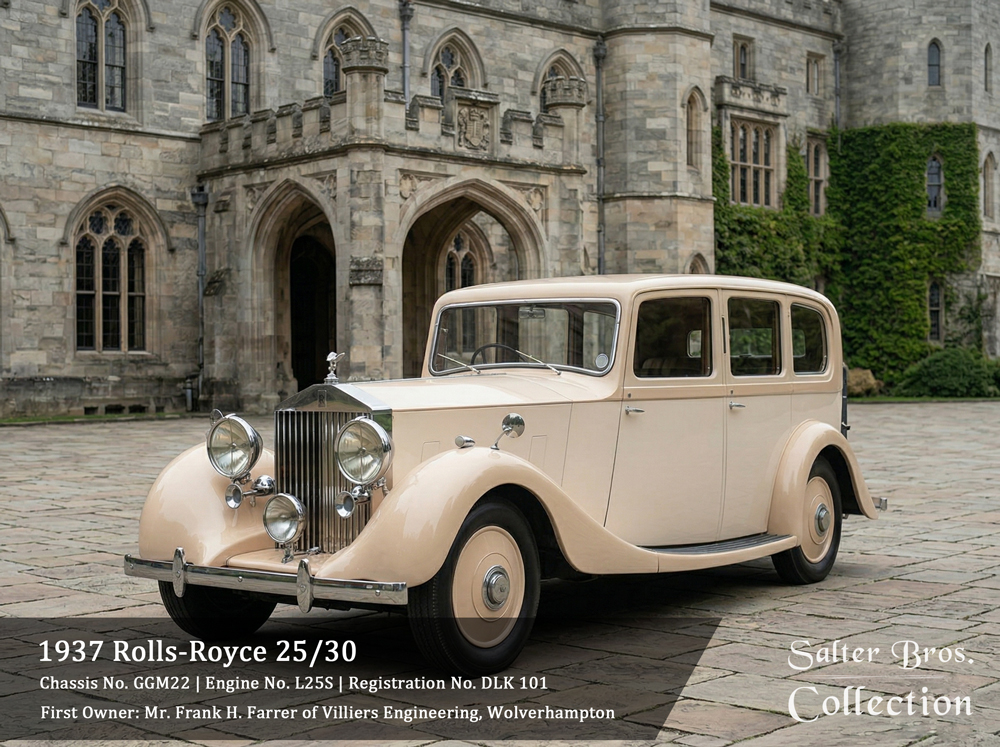
Frank H. Farrer’s Rolls Royce 25/30HP Limousine
The 1937 Rolls-Royce 25/30: A Legacy of Refinement
Chassis No. GGM22 | Engine No. L25S | Registration No. DLK 101
The Evolution of the “Small” Rolls-Royce
By the mid-1930s, the “Silent Guide” era of Rolls-Royce was facing a unique challenge: luxury coachwork (the body of the car) was becoming increasingly heavy and elaborate. To maintain the effortless performance expected of the brand, Rolls-Royce evolved the successful 20/25hp model into the 25/30hp in 1936.
The primary upgrade was the heart of the machine. The displacement of the smooth six-cylinder overhead-valve engine was bored out from 3,699cc to 4,257cc.
This 15% increase in capacity provided the necessary torque to carry grander, more formal body styles without sacrificing the “waftability” for which the marque was famous. To ensure modern reliability, the 25/30 also transitioned to more modern proprietary components, including a Stromberg carburetor and SU fuel pumps.
Engineering Excellence
While the engine grew, the 25/30 retained the meticulous mechanical foundations that defined the era:
- Chassis: A robust channel-section steel frame.
- Suspension: Traditional semi-elliptic leaf springs on all four corners, featuring adjustable hydraulic shock absorbers that allowed the driver to tune the ride quality.
- Transmission: A four-speed manual gearbox with a classic right-hand floor change.
- Braking: Mechanical servo-assisted brakes, a system originally licensed from Hispano-Suiza, which provided remarkably powerful stopping force for such a substantial vehicle.
The “Royal” Coachwork: Hooper & Co.
Chassis GGM22 was not just any 25/30; it was a long-wheelbase variant sent to the legendary firm of Hooper & Co. in West London. Known as “The Royal Coachbuilder,” Hooper held Royal Warrants dating back to Queen Victoria and was widely considered the most prestigious bodybuilder in the British Empire.
The “Enclosed Limousine” body they crafted for this chassis was designed for “Town and Touring”—meaning it was equally suited for formal city arrivals and long-distance continental travel.
Provenance and Delivery
On January 9th, 1937, the car was delivered to its first custodian: Mr. Frank Howard Farrer of Wolverhampton. Mr. Farrer was a man of significant stature; as the Managing Director of the Villiers Engineering Company, his choice of a Hooper-bodied Rolls-Royce was a clear statement of success and refined taste.
Key Specifications at a Glance
| Feature | Detail |
| Model | 25/30hp (Predecessor to the Wraith) |
| Engine | 4.3L Inline-6, Overhead Valve |
| Production Total | Only 1,240 units produced (1936–1939) |
| Body Style | Enclosed Limousine by Hooper & Co. |
| First Owner | Frank Howard Farrer (Villiers Engineering) |